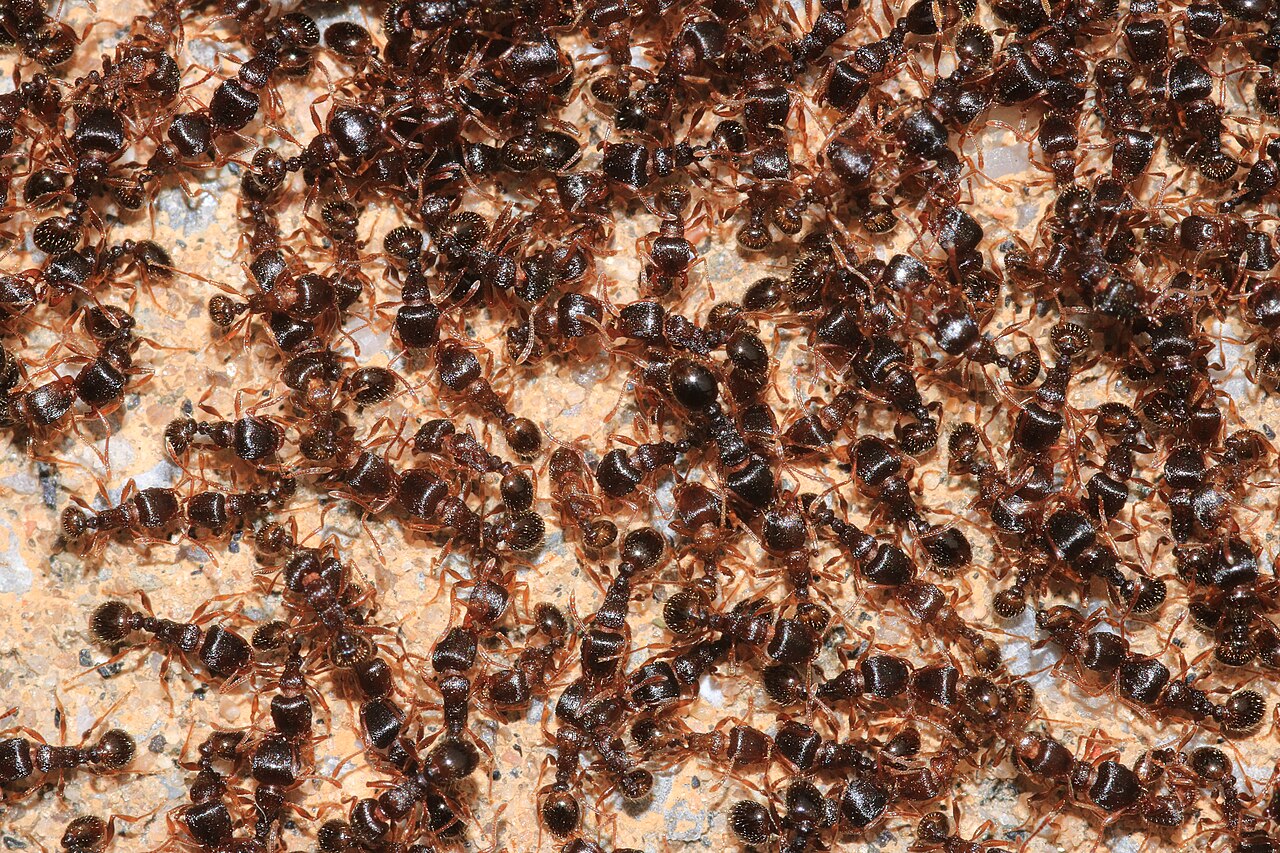
Ants
Ant Extermination in Council Bluffs, IA
Council Bluffs runs three ants that matter: the odorous house ant on the counter, pavement ants off the drive, and carpenter ants in damp basement wood.
Ant extermination in Council Bluffs usually comes down to three species, and telling them apart decides the fix. The odorous house ant is the small dark ant trailing to the kitchen, the pavement ant pushes up through slab cracks and driveway joints, and the carpenter ant is the big black ant tunneling damp wood in older full-basement homes. A house near the Loess Hills, a bungalow on the older west side, or a newer subdivision east of town can each get a different one.
The three ants a Council Bluffs home gets
The odorous house ant is the one most people see indoors. It is a tiny dark brown ant that trails along counters, baseboards, and around the sink, and it gives off a smell like rotten coconut when you crush it. It nests in wall voids, under floors, and outdoors in mulch and under stones, and it moves indoors fast when the weather swings between a hot humid stretch and a cool rainy one. Pavement ants are the small ants that mound fine soil at the edges of the driveway, patio, and garage slab, then forage indoors along the same slab.
Carpenter ants are the serious one. They are large black ants that do not eat wood but hollow it out to nest, and in Council Bluffs they go for the moisture-softened framing common in older homes with full basements: around a leaky basement window, a sweating pipe, a bad gutter line, or wood touching soil. Big black ants active indoors in winter, or a faint rustling in a wall, usually means a nest is already inside rather than out in the yard.
What you are actually seeing
The trail you see is a supply line between a nest and food, not the nest itself, which is why a kitchen spray clears the counter for a day and the ants return. Getting the species right matters because carpenter ants signal a moisture and wood problem that a bait aimed at sugar ants will not solve.
- A steady line of tiny dark ants to the kitchen sink, trash, or pet bowl means odorous house ants
- Fine soil mounds along driveway cracks, patio joints, and the garage slab edge mean pavement ants
- Large black ants indoors, especially in winter, or coarse sawdust-like shavings, mean carpenter ants
- Ants worst right after a heavy rain or a jump into humid heat, pushing indoors for shelter
- Winged ants at a window in spring, which point to a mature nest nearby rather than a stray forager
How a local exterminator clears them
The approach is baiting and targeted treatment, not a repellent spray that scatters the colony. An experienced local exterminator identifies the ant, places slow-acting bait the workers carry back to the nest, and treats the entry points: the slab cracks, the sill plate, utility penetrations, and the exterior foundation band where the trail comes in. For carpenter ants the work adds finding and treating the actual galleries and correcting the moisture that drew them.
Then the conditions that feed the colony. Trimming shrubs and branches off the siding, pulling mulch and firewood back from the foundation, fixing the gutter or hose bib that keeps the wood damp, and sealing the gaps around pipes and the garage slab all cut the food and moisture ants run on. Repellent sprays are the common mistake here, because they can split a colony into more nests and make the next month worse.
Why the weather swings bring them in
Ant pressure in Council Bluffs spikes when the weather jumps. A hot, humid Missouri River summer stretch drives ants to indoor moisture at sinks and tubs, and a heavy thunderstorm floods their shallow soil nests and pushes them straight indoors. That is why a lot of homes see their worst ant week right after the weather breaks one way or the other.
Getting ahead of it means baiting and sealing before the swing, not during the flood. A colony already being reduced by bait, with its entry points closed and its outdoor food cut, does not empty into the kitchen the way an untreated one does when the next storm rolls through.
Read more on what pest control costs in Council Bluffs, or call 712-220-7876 and describe what you are seeing.
Related
People who called about this also called about
Questions
Ants in Council Bluffs, answered
Why do the ants come back a few days after I spray?
A store spray kills the workers on the trail, not the nest, and a repellent one can split the colony into more nests. Bait that the workers carry back is what reduces it. Getting the species right matters too, since carpenter ants need the damp wood fixed, not just a bait.
How do I know if they are carpenter ants?
Carpenter ants are large, mostly black, and often active indoors in winter, which points to a nest inside the structure. You may find coarse shavings that look like sawdust below trim or a basement window. They target moisture-softened wood, so finding them usually means finding a leak or damp framing too.
Why are ants worst after a storm?
A heavy rain floods their shallow soil nests and pushes the colony toward dry shelter, which is often your kitchen or bathroom. Hot humid stretches do the same by driving them to indoor moisture. Baiting and sealing entry points before the weather swings keeps it from happening.
Are the ant baits safe around kids and pets?
Baits are placed in the trails and at entry points, not sprayed across living space, and can be set in spots children and pets do not reach. Ask the exterminator exactly what is being placed and where, and follow any instructions you are given.
Talk to a local exterminator
Call and describe your pest problem
Tell us the pest, the property and how long it has been going on. You get straight answers and an honest estimate before any work starts. No obligation.
Calls answered 7am to 9pm, seven days a week